Two socks can carry the same logo and cost wildly different amounts, hold detail differently, and feel like different products in the hand. The reason is the method used to put the design on them. For a smooth athletic crew, the choice between a knitted design and a printed one is mostly aesthetic. For a fuzzy sock, it is closer to a physics problem, because the plush pile that makes the sock cozy is the same thing that fights against a printed image. Here is how the two routes actually differ, what the pile does to each, and the real numbers on minimums, price, and lead time so you can spec a run without surprises.
Two ways a design gets onto a fuzzy sock
Knit-in, or jacquard, builds the design into the fabric itself. Computer-controlled needles carry several colors of yarn and switch between them stitch by stitch, so the pattern is made of the actual plush yarn rather than sitting on top of it. Because the image is structural, it distorts far less when the sock stretches over a foot, and it can use the same performance yarns the sock is already made from. The trade-off is color count and fine detail: each color is a separate yarn the machine has to manage, so most knit programs are comfortable with a handful of colors and bold shapes rather than photographic gradients or tiny text.
Printing, usually dye sublimation, works the opposite way. The art is turned into dye that is driven into the fibers under heat, which opens up essentially unlimited color, gradients, and photo-quality detail. On a smooth polyester crew, that produces striking, edge-to-edge graphics that knitting cannot match. The catch is that sublimation needs a flat, tightly woven polyester face to hold that detail, and it tends to leave a slightly sleeker surface because the process works against loose fuzz.
Why the pile pushes you toward knit-in
A fuzzy sock’s whole appeal is its raised nap. That nap is exactly what a printed image struggles with. When dye lands on a long, brushed pile, the individual fibers scatter the pattern and the edges blur, and the pressure and heat of the process flatten the very fuzz you paid for. As a rule, then, the more plush the sock, the more a printed graphic loses both crispness and softness. Knitting the design in avoids the conflict entirely: the pattern is made of plush yarn, so it stays fuzzy and stays sharp through wear and washing. In practice, most genuinely fuzzy socks get their designs knit in, and printing is reserved for smooth socks or for a flat area such as a footbed or a low-pile cuff panel where the surface can behave. If your concept depends on a photograph or a dense gradient, the honest answer is often to choose a smoother sock; if it depends on the sock actually being fuzzy, plan the art around knit-in color blocks.
Minimums, price, and lead time
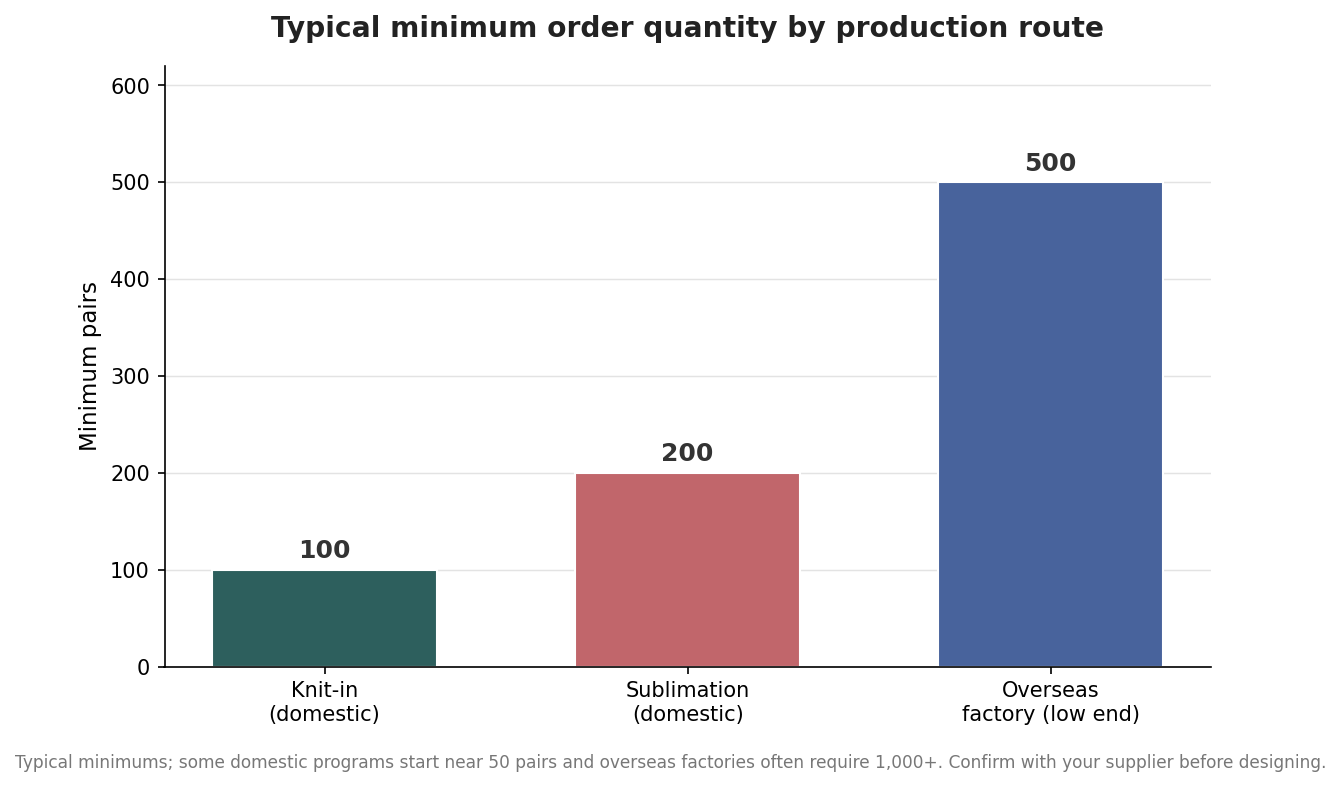
The production method also sets your entry point. Domestic knit-in programs commonly start around 100 pairs, sublimation around 200, and overseas factories usually want 500 pairs at the low end and often 1,000 or more. Those minimums exist because setting up a knitting machine or a print run carries fixed cost that only makes sense spread across enough pairs.
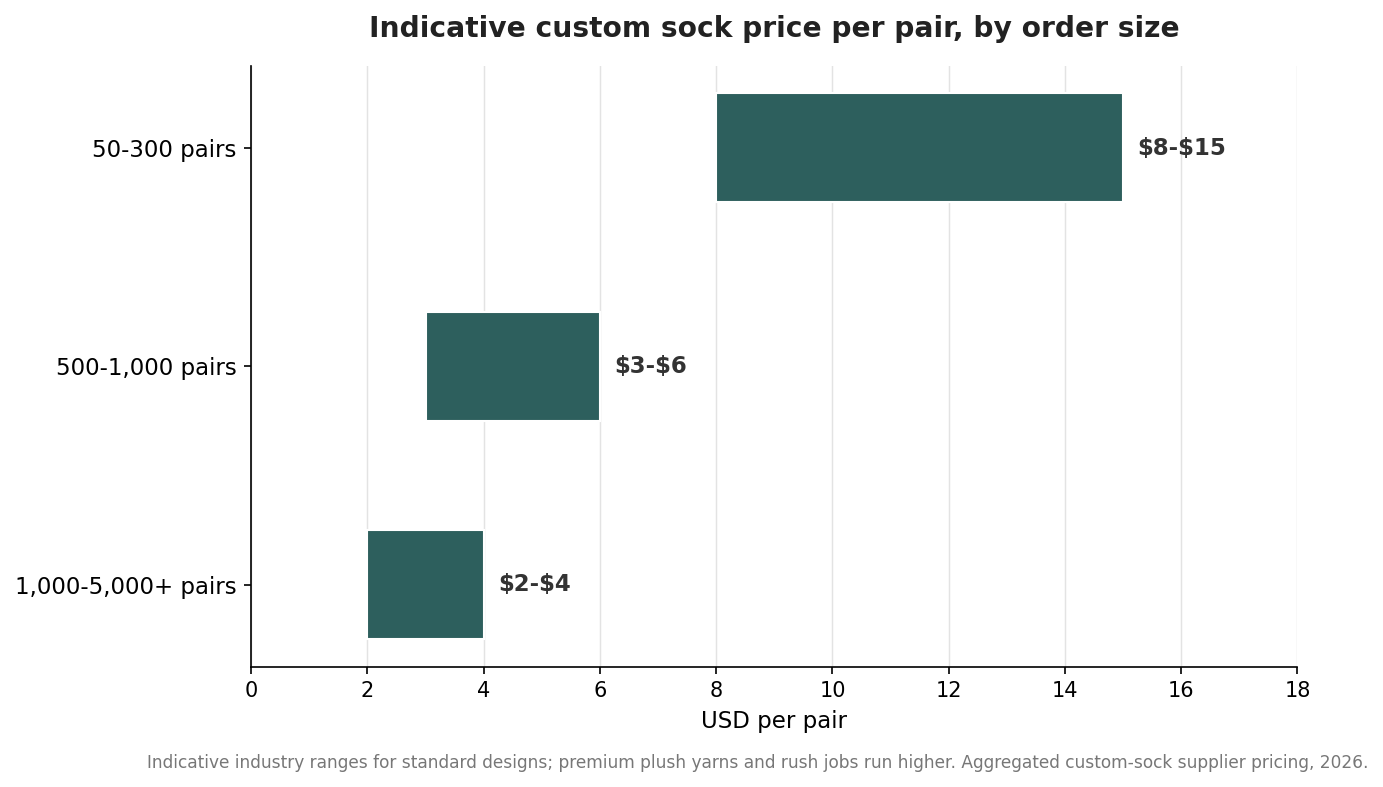
Price per pair then falls steeply with volume. Small runs in the 50-to-300-pair range commonly land around $8 to $15 or more per pair, the 500-to-1,000 band tends to fall to roughly $3 to $6, and once you are ordering 1,000 to 5,000 or more, standard designs often sit near $2 to $4. Plush and specialty yarns, extra colors, and rush timing all push those figures up, so treat the ranges as a starting map rather than a quote.
Lead time is the number most often underestimated. From approved artwork, domestic production commonly runs about 8 to 10 weeks, and overseas roughly 6 to 12 weeks before shipping and customs. The clock starts at art approval, not at your first email, so a seasonal or holiday order works backward from the delivery date with a comfortable buffer. If you need socks in hand by early November, artwork should be locked by late summer.
The materials that actually stay fuzzy
Method aside, the fiber decides how the sock ages, and this is where cheap runs disappoint. Chenille, a velvety tufted yarn, is widely treated as the softness benchmark; it feels silky and holds its texture through repeated washing, at the cost of some breathability. Microfiber fleece, made from ultra-fine polyester, gives a plush but lightweight hand, dries quickly, and wears well. Sherpa-lined constructions pair a smoother outer with a thick fleece interior and are the warmest option, trading a little of the surface fuzz for insulation. The one to watch is plain acrylic, which is cheap up front but pills far faster; density-for-density, acrylic can pill on the order of two to three times faster than polyester blends and often starts matting within the first five to ten washes. A knit-in design on a good chenille or microfiber sock still looks sharp after a season; the same design on thin acrylic can look tired quickly, which is why the yarn spec matters as much as the art.
Two functional details are worth locking down while you are at it. If the socks will be worn on hardwood or tile, specify gripper soles, the silicone or rubberized dots across the ball of the foot, since they are a real safety feature and not just decoration. And confirm the size model up front, because fuzzy socks are frequently sold as one-size or in broad small, medium, and large bands with generous stretch, while a true size run splits adult feet into ranges such as roughly US 4 to 8 and 9 to 13. If you are gifting to a known group, a graded size run fits better than a single stretch size.
How to choose for your run
Start from the sock, not the logo. If the point of the order is that the socks are unmistakably fuzzy, choose a plush chenille or microfiber base, keep the artwork to a handful of strong colors and clean shapes, and knit the design in. If the point is a bold, photographic graphic and a plush hand is secondary, accept a smoother sock and let sublimation do what it does best. Match the quantity to the method’s minimum, build the timeline backward from when you actually need the socks, and put the yarn type in writing alongside the art. Get those four decisions right and the finished sock will look the way it did on screen and still feel the way it should after a winter of wear.